Showing posts with label Fingerprint Attendance System. Show all posts

Saturday, 5 July 2025

Fingerprints and Trust: Data Integrity Meets Daily Attendance


With the development of technology, the biometric attendance system has become one of the preferred choices for attendance marking. Biometric information contains the unique physical and behavioral characteristics of an individual. In the machines those details are used for verification of identity and for authentication purposes. The data may contain

1.       Fingerprints: The ridges present on the fingers of an individual.

2.       Voice Recognition: Differentiating vocal qualities of pitch, tone, and cadence.

3.   Face Recognition: Studying facial metrics. It covers the threshold value of distance between eyes, nose type and jawline pattern.

4.       Iris Scans: Patterns in the colored circle of an individual’s eye.

However, biometric data poses privacy issues. This blog discusses various ways to secure user biometric data captured in a biometric attendance machine.

Best Practices for Data Security, and Privacy in Biometric Attendance Machine

Implementing Strong Encryption

One of the most important facets of securing biometric information is the use of strong encryption. This involves using standard encryption algorithms such as AES-256. Work on encryption algorithms to keep up with potential threats while keeping your data secure.

For example, when a person places a finger on the attendance machine for fingerprint scanning, that data should immediately get encrypted and sent to the central database. Thus, even if the information is intercepted, it is unreadable by foreign or domestic intruders without the decryption key.

Restricting Access to Authorized Personnel

Security and access control to biometric data should require restriction. Organizations should:

●      Implement role-based access control (RBAC)

●      Employ multi-factor authentications for administrative access

●      Periodic access review and permission update

When only job-required users have access, organizations can greatly decrease risk of internal data breaches or abuse.

Securing Biometric Devices

Biometric attendance machines are as vulnerable to physical security as they are to digital security. The team should use devices in controlled environments with restricted access. They can also use tamper-evident seals to identify physical tampering. There may be real-time alerts to any unpermitted devices attempting access

Regular Audits and Monitoring

Periodic audits and ongoing monitoring of biometric attendance machines are critical to preserving the integrity of biometric data. This includes conducting periodic security assessments. For example, SIEM (security information and event management) tools can be employed to monitor biometric systems and provide real-time alerts on any abnormal activities.

Data Minimization and Retention Policies

The policy is a must for everyone to follow. Only capture what you need for attendance with biometric data collection. Start by defining retention policies for how long data is kept. Organizations can use data minimization to limit the risk of keeping biometrics.

Legal and Regulatory Compliance

Compliance with applicable statutes and regulations is particularly important in the context of biometric information. Above that, the management may remain informed consent and transparent.

Employee Training and Awareness

Training employees on the importance of biometric data security is also important. Training on data prevention and security shall be conducted on a regular basis. Decide on using the biometric attendance system in a safe manner, and issue the directives clearly

Conclusion

Above all, keep in mind that biometric data protection is an ongoing effort. It can never be fully  completed, but requires a permanent vigilance and response to new threats and technologies. The first and foremost step is to choose a biometric attendance device which comes with advanced features to make it safe to use.

Monday, 23 June 2025

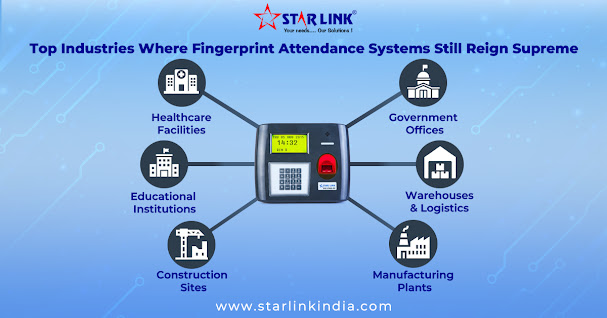
Top Industries Where Fingerprint Attendance Systems Still Reign Supreme.


There are always situations where companies need to think outside the box to enhance security and implement better-streamlined processes. For companies, technologies have played a significant role in managing their day-to-day work, as well as human resources.

Many digital transformations are complex solutions, but sometimes, the simplest methods bring a drastic change. Fingerprint attendance systems, though not new, continue to dominate various industries. It brings reliability, safety, efficiency, affordability, and ease of use.

In this blog, we'll discuss the top industries where these systems play a significant role. It's not as if these systems don't apply to them. Regardless of industry or business size, implementing a biometric attendance system is a strategic move.

Why do Fingerprint Attendance Systems Still Matter?

The mention of fingerprint systems often brings images of crime scene investigations and biometrics in spy movies. However, the reality is much more down-to-earth. These systems bring straightforward solutions to a universal problem.

Most importantly, it helps with accurate and foolproof attendance tracking. Unlike ID badges or numerical codes, fingerprints provide a unique identifier that eliminates common issues such as buddy punching or card swapping. This creates a trustworthy environment, reducing payroll errors.

Industries Where Fingerprint Attendance Systems are Widely Used

Healthcare Facilities

In the healthcare sector, accurate person tracking is needed not only for administrative and organizational but also for safety reasons. Fingerprint systems can be very beneficial in hospitals and clinics for:

It grants authorization for entry to locations such as operating theaters or pharmacies. Healthcare providers can track staff sign-in and sign-out times, making shift management a breeze, so caring for patients is never jeopardized.

Government Offices

The government offices are widely believed to be understaffed, with staff not arriving or departing on time. A fingerprint attendance system not only helps in preventing this, but it also helps in increasing efficiency. It is also possible, with the use of fingerprint attendance systems, to eliminate paperwork for routine checks of employee movement in and out.

There is reduced ID theft. The system verifies that only legitimate employees enter buildings and access systems. Administration can gain access to verifiable logs of employee time and attendance, which are essential for accountability and record-keeping.

Warehouses & Logistics

In the logistics industry, time is of the essence. Factories and warehouses can use fingerprint machines to ensure that only authorized personnel enter, with an ideal doorbell positioning that can help reduce unnecessary motion alerts. Consider a busy distribution center, where timing and coordination are crucial to maintaining supply chain efficiency. Fingerprints are brilliant as they are fast and do not require staff to hold onto or lose cards in a logistics environment.

Manufacturing Plants

In the manufacturing sector, fingerprint systems are advantageous, as they align with our industry's imperative focus on accuracy and performance. These systems improve workstation security. Staff get controlled access to keep unauthorized individuals out of work areas and away from equipment and intellectual property. Moreover, logs on staff movement maximize shift changes and emergency roll calls.

Construction Sites

Construction sites are fast-paced with high staff turnover. Sometimes, the site has a large number of staff. The fingerprint attendance machines provide up-to-the-minute employee presence, thereby reducing safety hazards. Construction managers save time on project delivery, not paperwork.

Educational Institutions

Fingerprint systems are used in schools and universities primarily for staff and, increasingly, for student attendance as well. The key benefit is that access to facilities is restricted to registered students and verified staff. It also makes the systems easier or more efficient for record-keeping on your side.

Conclusion

Fingerprint attendance systems are being widely adopted in various industries as they successfully combine technology with ease. We're in a time when high-tech solutions are in high demand. Still, affordable fingerprint attendancemachines remain a go-to option for various industries. The manufacturers of these machines are also adopting new technologies to remain relevant in these changing times.

To learn how you can bring about drastic change in your organization, schedule a free consultation with India's leading biometric attendance system manufacturer and service provider, Star Link India.

Friday, 22 February 2019

How do fingerprint scanners work?


Gone are those days when fingerprint scanners were reserved to high-end security facilities and government organizations. Today, even a mid-range mobile phone comes loaded with a fingerprint scanner. These fingerprint sensors are the most widely used application of biometrics.
Given their popularity, it makes complete sense to dig in further and try and learn more about them. I’m pretty sure that most of you don’t know about the 3 widely used fingerprint scanners. Well, quite a few fingerprint technologies have been developed but most of them failed to witness their widespread implementation. Keeping it in mind, let’s know more about them and learn what the major differences are.
1. Optical Scanners
These are the oldest known method of capturing, identifying and storing fingerprints. This technique relies on capturing an optical image (mostly through clicking a photograph) and using various algorithms to identify unique patterns on the skin’s surface. Optical scanners use LEDs to illuminate the finger pressed against the glass plate. This light, when reflected on the Charged Couple Device (CCD) generates signals which are ultimately processed to create a finger’s digital impression. This imprint is what we call a live scan.
A major handicap with optical fingerprint sensors is that they can be easily manipulated. The 2-dimensional imprints can be fooled using prosthetics, or even good, high-resolution pictures. And thus, it is being phased out today and can only be found in inexpensive hardware.
2. Capacitive Scanners
This is the most commonly used fingerprint scanner and can be found implemented in various flagship devices. The capacitor, just like its name suggests is the core component in these types of scanners. Unlike optical sensors, capacitive fingerprint scanners do not create a traditional fingerprint image. Various semiconductor chips are embedded into such scanners. These chips comprise of cells made up of capacitors. Such scanners use multiple capacitor circuits to data about a fingerprint.
Once such data is collected, it’s thoroughly analyzed for any distinctive attribute, which is then saved for comparison. A good thing about these kinds of fingerprint scanners is that they are not easy to fool. However, they are prone to software/hardware hacking and manipulation.
3. Ultrasonic Scanners
Ultrasonic scanners, in an attempt to capture fingerprint details, use an ultrasonic transmitter and a receiver. Whenever a finger is pressed against the sensor, an ultrasonic pulse is generated. While a part of it is absorbed, most of it bounces back to the sensor. The waves are then utilized to recreate a digital imprint of the fingerprint.
Fingerprint recognition is an integral component of biometric identification, but not its only one. In our subsequent blog posts, we’d throw some light on other identification technologies such as iris recognition, vein recognition, etc. Until then, keep following Starlink Communications, India’s leading biometric manufacturer.